|
||||||||||||||||||
Accuracy in Paintball - Part TwoAccuracy in paintball
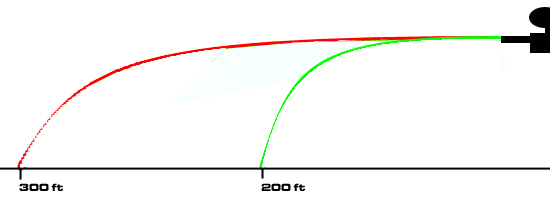
In part one we talked about the physics of paintball and briefly covered the operation of your typcial paintball marker to get a foundation for the rest of this guide. If you haven't read it yet, be sure to read Part One in this series to get yourself up to speed. Variables and their affect on paintball flight Now that we’ve got a groundwork laid down about the physics, particular paintball items, and the process of how a paintball is fired we can start to look into how all these things get tied together. That’s right, all this stuff is related somehow to one another. Now is a good time for a potty break if you need it. Velocity vs. Distance First up is Velocity vs. Distance. We all know that a paintball will leave a barrel at a given velocity. Using an adjustment of some sort we try and control that velocity to keep it in a safe range. However, when it comes to accuracy, a “range” isn’t good enough. To be accurate, the velocity that the paintball leaves the barrel needs to be as consistent as possible…the exact same every time would be ideal but we’ll get into why that isn’t always possible in a bit. Let’s say you shoot two paintballs from a height of 9 meters. One is shot at 200 fps and the other is shot at 300 fps. The barrel is level to the ground for both shots. Figure 1 is a rough (very rough) drawing of what their trajectories might look like.
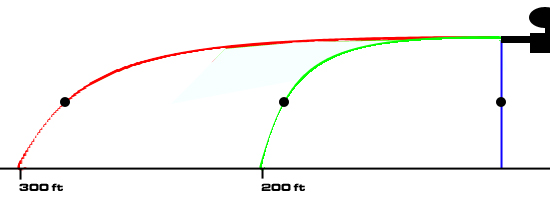
Obviously the one shot at the higher velocity travels further. But now let’s say you’re shooting at a target that is about 175 feet away. In Figure 2 (below) the target is the blue rectangle.
Note how much lower on the target the ball traveling at 200 fps strikes compared to the ball shot at 300 fps. Now granted this is an extreme example but the concept is what is important. This also demonstrates why it is that at closer ranges accuracy is not as much of a problem as it is the further away your target gets. There is another thing to think about as well and that is how far the ball drops over time. In the Figure 3 below, the black dots on the paths represent paintballs after just about 2/3rds of a second after they have left the barrel. Again, the red line represents a ball shot at 300 fps, the green line is 200 fps and now the blue line represents the path of the ball if you just held it up at the same height as the barrel and dropped it at the same time the other two balls were shot from the barrel.
Notice how regardless of their forward momentum, they all “fall” to the ground at the same rate. So velocity not only affects how far the ball will travel but also how quickly it will get there as well. Aerodynamics The only other factor that will affect the path of the paintball along these two axis (remember, the ball traveling away from the marker is one axis of movement and the ball falling because of gravity is the other) is aerodynamics. A ball leaving the barrel at 300 fps will not actually travel 300 feet in one second. As the ball travels through the air, drag is gradually slowing the ball down. Thus at 100 feet away from the barrel of the marker the ball may only be traveling 270 fps when it was originally shot out of the barrel at 300 fps. Remember, the only way to overcome drag is with thrust and once the paintball leaves the barrel of the gun there is no force keeping it from being overcome by drag other than its own inertia. Now note that not every projectile is affected the same way by aerodynamics. A real bullet is far more aerodynamic than a round paintball. By being more aerodynamic it creates less drag as it passes through the air. Because of this, it will not be slowed down as dramatically as a paintball would be. This is one inherent problem with paintballs and range. Because they are round and, so far, no alternative shape has been found that can conveniently be used in the sport all paintballs suffer from the same basic aerodynamic flaw.
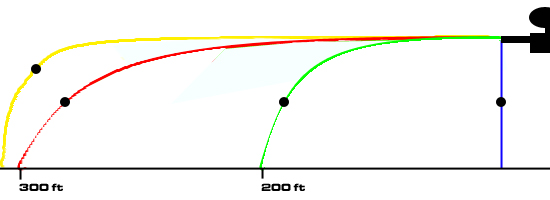
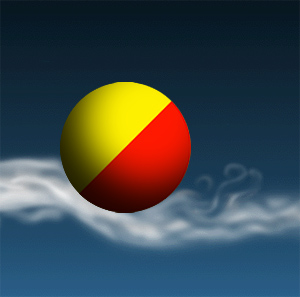
Another aerodynamic issue when it comes to paintball is lift. The Tippmann Flatline barrels and the Apex barrels both impart a backspin on the paintball as it leaves the barrel. When the ball leaves the barrel, this backspin causes the air passing over the top of the ball to move faster than the air traveling below the ball. One principle when it comes to air pressure is that the faster the air is moving, the less pressure it has. Thus the bottom of the ball has more air pressure pushing against it than the top. (The official name for this is the Magnus Effect.) We call this lift and it’s the same force that allows planes to fly. Lift counteracts gravity. So long as lift is equal to the force of gravity the ball will never fall from its original path. However, the lift generated by a back-spinning ball will not remain constant. It will decrease as the ball slows down because of drag. Even so, a ball with a back spin on it will actually have less drag than a ball that doesn’t so it will also take longer for a back-spinning ball to slow down. This means that not only will a back-spinning ball take longer to fall to the ground but that it will also travel further over the same course of time as a ball fired at the same velocity without a back-spin. The chart below has added another line (yellow) representing a ball fired from a Flatline style barrel at 300 fps.
Note how the ball has traveled slightly further, is higher, and had a flatter trajectory than the ball shot from a non-Flatline barrel at the same velocity. It is important to keep in mind that these numbers are arbitrary and that actual velocity will be dictated by the field or the barrel. For instance, most fields limit the maximum velocity a paintball marker can shoot to 285 fps or less. A Flatline, because of its design, will actually cause balls to curve upwards if the velocity of the marker is set too high. Generally Flatlines give the best performance at around 260-270 fps. Even when giving up 15-25 fps to a standard barrel though, the Flatline will shoot further because of the aerodynamic effects placed on the ball by the barrel. We’ll get more into barrels in a bit so right now just keep the basic principles of how velocity, gravity, and aerodynamics play a part in how the ball travels towards the target.
Now aerodynamics affects paintballs in flight in other ways as well. The first is what is called von Karman vortices. As air passes over a paintball, it doesn’t do it in a smooth linear fashion. Take your hand and move it through a pool of water and you’ll notice that the water tries to fill in the space behind your hand in a swirling fashion. Air moves the same way and these “swirls” are call vortices. While I could go into great detail about vortices what is important to note is that clear air is high pressure air and “disturbed” air, such as vortices, is low pressure air. As a paintball flies through the air, these vortices are constantly forming on the surface of the paintball. Unfortunately at the speed at which the ball is traveling they do not form in an even or predictable manner. That means there are high and low pressure spots forming and disappearing randomly all over the paintball as it flies towards the target. As we learned before an area of high pressure will push the ball in a direction that is opposite the area of high pressure. This means that as these random vortices are formed the ball is constantly being pushed all over the place from these high pressure areas. Now, fortunately they are not all that strong and for the most part cancel each other out. So why mention them? Of course, other things can affect these vortices as well. Paint on the outside of the shell will cause more drag on that side of the ball causing larger vortices and again sending the ball out of control. The further away a ball is from being perfectly round the more it will be subjected to these vortices as well as issues with gyroscopic forces that will push it even further off course. Wind The last factor in paintball flight is perhaps one of the more obvious. Wind can alter the flight path of a paintball dramatically. Paintballs are generally not very heavy weighing in around 3 grams. Even the slightest breeze can push the round off course. Other than adjusting the aim of the marker, there isn’t much you can do about wind. Just be aware of its effect. In the barrel So now that we talked about what affects a paintball during flight let’s talk about what is going on inside the barrel. Up to this point we have talked about the ball leaving the barrel at a particular fps and how this can effect where the ball flies. However, what we haven’t mentioned are the dynamics of what’s going on inside the barrel leading up to that point.
Gas There are two values that affect how a gas accelerates a paintball up to speed, Pressure and Volume. Pressure we’re all pretty familiar with. The more pressure you use the greater the velocity of the paintball. However, what many may not know is that pressure isn’t the only thing that affects velocity. The amount of gas, or volume, will affect it as well. The greater the volume, the greater the velocity. This is how one marker that has an operating pressure of 600 psi will fire a paintball at the same velocity as a marker that operates on 150 psi. The 150 psi marker uses a greater volume of gas to achieve the same velocity. Expansion However, the amount of gas your valve lets out is very small at 400 psi and after the paintball travels about 6-8” down the barrel the pressure of the gas has dropped significantly and the paintball is no longer being pushed down the barrel. A marker that fires at 150 psi would have more gas released when the ball was shot but would not need to equalize as much since it is at a much lower pressure so even in low pressure markers the 6-8” rule holds true. If the ball fits…
There is more to the equation though than just expanding gas. The paintball and barrel also play critical roles in the velocity of the paintball. The big factor at work here is friction. Now we mentioned that an object at rest tends to stay at rest unless acted on by an outside force. In our case, the paintball is the object and the gas coming out of the bolt is the outside force. To move the ball, the gas must push with more force than the force that is holding the ball in place. As was mentioned paintballs are very light and the gas behind the paintball has more than enough force to get the paintball moving. However, there is another force trying to hold the paintball in place…friction. This friction is between the ball and the barrel. The greater this friction, the more force the gas must use to get the ball moving and the lower the overall velocity so long as the same amount of gas is released at the same pressure. We can use more gas or release it at a higher pressure to overcome additional friction though. (Up until the force required to overcome the friction is greater than the shell can tolerate. Then the ball breaks and you have a huge mess to clean up in the barrel…) However we don’t want to eliminate that friction. The same friction that is created by the ball being pressed against the barrel also causes an air tight seal behind the ball. This allows for all the gas expelled from the bolt to be used to push the ball down the barrel. A ball that doesn’t have a good seal in the barrel will allow gas to bypass the ball thus wasting its energy rather than using that energy to push the ball out the barrel. We will cover why this is important a little later on. Friction over distance Now once the ball is moving the friction between the ball and the barrel increases as the speed of the ball increases. Also, the longer the barrel the longer the ball is subjected to this friction. Remember that after the first 8” of the barrel the ball is no longer being pushed down the barrel. If the barrel is longer than 8” the friction will cause the ball to slow down from the 8” mark until it leaves the barrel. What this means for us is that a ball leaving the barrel at 300 fps could be traveling at 370 fps at the 8” mark of the barrel and decelerating down to 300 fps by the time it reaches the end of the barrel. That's all for now... That wraps up this part on accuracy. Next up, putting all this knowledge together and seeing just what we can do to make our paintball markers as accurate as they can be.
Good luck and remember, it is all about having fun!
- Robotech
|