Paintball snipers -- real or imagined? (update 2013)
Back to the home page...
 |
| The Tiberius First Strike round. The paintball that changed everything when it came to paintball snipers. |
The Loch Ness Monster, Bigfoot, and Paintball Snipers…
To many paintball players all three of those are fictional characters and none of them could get to the dollar bill. If you don’t get that reference go rent “Chasing Amy”. That’s all I’m saying.
But back on topic. Do “Snipers” exist in paintball? Short of the ever present “What marker to buy” threads, posts about snipers in paintball rank high on every single paintball forum and yet no other topic will stir up as much of a debate as this one. Up until a couple of years ago this was a much greater debate than it is today. So what changed? Simple, the new First Strike rounds with their bullet like shape, improved range, and greatly improved accuracy over standard paintballs have made having a true “sniper” with accurate, long distance shots more of a reality.
Sniper up!
It used to be the main argument over why there were no snipers in paintball was the fact that every paintball gun fired the same distance and all suffered from accuracy issues. Even with the new First Strike rounds making that position harder to stand on, what that is really saying is that in order to be a sniper your “gun” must outshoot the other guy’s.
So really, the argument isn’t whether there are snipers in paintball but rather just what, exactly, makes a sniper a sniper? In a quest to answer this I’ve recently gone over several first person sniper stories that have ranged from revolutionary times to present day and have covered both military and paramilitary snipers (i.e. police SWAT snipers). There are many things that go into being a sniper and yes, accuracy at long distance happens to be one of them but it took more than just a good shot to become a sniper even in the military. So let’s break down some of these criteria.
- Marksmanship - All snipers have to be good shots. They have to compensate for variables such as wind, humidity, distance, terrain, target movement, time of flight for the round from shooter to target, and relative elevation of the target to the shooter. Compensating for all these variables to make sure the sniper’s first round is the only round he needs to shoot takes months of training and tons of skill especially if the shot was extremely long range.
- Equipment - The sniper’s equipment included not only a scoped weapon but also things such as ghillie suits, rations for spending days in the brush, drag bags, radios, notepads, and other various tools of the trade. Sometimes, and in more modern units, the sniper’s role has expanded from just expert marksman to scout/recon as well so their equipment bundles have expanded to match. However, the main tool of the sniper is his rifle and usually, but not always, the magnification scope sight attached to it.
- Stealth - A sniper was more than just a well-equipped marksman though. Snipers many times operated behind enemy lines and needed to avoid detection. Whether they stayed in a hidden location while the rest of their troops pulled out leaving them to wait until the enemy troops moved in or inserting themselves into enemy occupied territories the sniper had to avoid detection. Often times he used a combination of stealthy movement and advanced camouflage to achieve this. Either way, being stealthy is just as important to a successful sniper as his marksmanship because it doesn’t matter if he can hit his target if he can’t get to it.
- Mental Fortitude - This is something that is sometimes hard to measure. Snipers had to have a certain attitude in order to look at a man’s eyes through his scope and still be able to pull the trigger. Snipping is a very personal type of warfare. However, they also had to have the mental ability to exercise incredible patience to stay in hidden locations sometimes days on end defecating in their pants while being eaten alive by bugs in order to get off that one critical shot. Also, the sniper has to be able to distinguish when he should take a shot and when he shouldn’t. He has to be able to determine which targets are important and which are not.
 |
| A scope, long barrel and cammo does not a paintball sniper make. |
These are the main things that I feel define a sniper. As they said in the Marine Corp though, you’re a Marine first and a Sniper second. This means that snipers could perform all the tasks that a regular grunt could perform and his sniper abilities were in addition to his ability to perform as a regular infantryman. Not only that, but many times snipers today carry weapons that do not necessarily outdistance those of their opponents. In some situations, they actually have weapons that don’t match the range of what their targets are shooting.
Taking all these factors into consideration and the fact that even in the “real world” a sniper is not defined by his weapon, but his ability to make his shot against a target that is unaware they are being targeted and then exfiltrate without being discovered.
Paintball Snipers don’t exist!
Or so they say. The best way I can think of starting this is to go over just what the argument is against paintball snipers.
- Paintball Markers all shoot the same distance - True. Even with the range extending barrels out there you still have to get the ball to break on the target for it to count and sometimes this can be a problem at extremely long ranges. First Strike (FS) rounds have changed all that. Due to their unique shape, FS rounds are more aerodynamic than standard paintballs. Even though both a FS paintball and a standard round paintball leave the marker at 280 or so Feet Per Second (FPS) the regular paintball will slow down quicker. Thus, after a distance of 100 feet the regular paintball has slowed to 200 fps, the FS paintball may be moving at 240 fps. In addition, the shell of the FS round is manufactured from a different material than a regular paintball. Because a regular paintball may load with any side facing the bolt, every side of the paintball must be durable enough to resist breaking when hit but the burst of air firing it. Because the FS rounds will be loaded in a known direction, only the back of the round has to be durable, the front is more fragile than a standard paintball and thus will break at lower speeds. This means that while a regular paintball could hit someone at 200 feet it wouldn’t break at that range unless you hit a very hard part of the target’s equipment (mask, hopper, gun, pod, etc). The effective range of a regular paintball was about 150 feet or less with hope of it breaking against soft areas of the target. A FS paintball with its more brittle front will break on soft targets at longer ranges giving in at least double or more effective range than a standard paintball.
- Snipping is another term for Camping - It is true that some “form” of snipping can be considered camping. If you’re setting still in a certain location where you know opposing troops will be advancing and are concealed your team mates may call that being in a “sniper hide” but your target is going to tell you that if you want to camp like that to join the Boy Scouts. While this may have some truth, again the situation determines its relevance. If you’re playing recreational paintball and you’re doing this, then the camping term may be justified. If you’re playing a scenario game running a mission and your spot is in support of that mission (keeping reinforcements from showing up, protecting a target from a lone enemy that makes it through other defenses, etc.) then you have a purpose and are playing in more of a “sniper” role.
- Paintball guns are too loud - Also can be true but there are also some wickedly quiet guns out there. Don’t expect a Spyder to be quiet as no stacked tube blowback generally is but cockers, electro-pneumatics, and pumps can be extremely quiet. One of the quietest markers out there now is the Dye DAM with FS capability. With its quiet shooting and the additional range of the FS round, the DAM could prove to be a near silent shot to the target.
- You have to be close to make sure you hit your target – When we only had standard paintballs you had to make sure you hit your target and go ensure that the ball would break required you to be very close to your target thus making it much harder to stay concealed after the shot. With the new FS rounds, this is no longer the case. Often times a FS shooter can take a shot from such range that the target cannot figure out where the shot came from since they do not expect to get shot from that range. Also, the further you are from your target, the harder it is for them to see you and concealment makes a much bigger difference.
- Just because I sneak up on someone and shoot them unexpectedly doesn’t make me a sniper - You’re right, it doesn’t. This is true too in the military that often times a trooper may sneak up on an unsuspecting enemy and get a kill without the other person knowing where it came from but that doesn’t mean they get sniper pay. The difference between a sniper and a standard shooter comes in their ability to get into places and take shots from places against specific targets which a normal shooter would not be able to do and do so with accuracy, not firepower.
- Snipers take out only important targets – Partially true. The hitch is to define “important”. Most will take it to mean important people such as heads of state, generals or other high ranking officers, and the like. However that isn’t always true. Yes, snipers have been called on to take out such targets but they usually are called on for much more mundane targets too. More often than not, snipers will augment regular troops. For instance, in Vietnam when a platoon entered a suspected VC village the VC would know the platoon was coming and start sneaking out the opposite side of the village. One way U.S. troops countered this was to place sniper teams at the “back door” to take out those VC that tried to get away. After one or two of their comrades fell to the sniper’s weapon the rest usually took cover and thus would remain in the village. Thus, in these missions, the first couple of enemy troops were the “important targets” even though they were nothing more than common troops. Same today in Iraq. U.S. snipers would move ahead of standard units to soften the area before the main force moved in. Again, they were targeting regular units yet taking these units out at critical times made a big impact on the overall mission.
So with all that snipers can’t exist in paintball, right? Not exactly. First let me start by saying that I do believe the ONLY place you COULD have a paintball sniper is during a scenario or “big” game. Most recreational fields are not conducive to true snipping tactics. Let’s break some of these arguments down.
- Paintball Range - Saying that because all paintball markers shoot the same distance thus you can’t be a sniper is assuming that a sniper’s weapon MUST shoot further than his target’s or he is not a sniper. This is FALSE. In the wars before Vietnam often times the only difference between a “Sniper” weapon and the weapons carried by normal troops was nothing more than the shooter’s ability to hit his targets better than his targets could hit him. German snipers in World War II would use concealment to “ambush” American patrols and thus slow their advance. Even in Vietnam, there are many stories of snipers lying still while the enemy’s bullets would pepper the forest around them because they didn’t know where the sniper was but it was certainly clear that they were still within range of the enemy’s weapons. Also, many “sniper” engagements…especially when you are talking about SWAT snipers…occur at ranges of 400 yards or less, a range well within any assault or hunting rifle. In Iraq, snipers used weapons that wouldn’t necessarily outdistance an M4 or M16 but were more accurate. Thus the range of one’s weapon does NOT SOLELY determine if you are a sniper or not no matter if we are talking paintball or real warfare.
In addition, the new FS rounds gives players the ability to have a marker that will outdistance a marker that doesn’t fire FS rounds. Tiberius (“makers” of the FS round), Kingman, Dye and a host of other companies are now making markers that are designed to fire these new rounds. With their increased effective range, this makes the “equal range” argument even less valid.
- Snipping is Camping - Okay, this one is really a matter of opinion. If someone sneaks through the opposing team’s line and sets himself up somewhere in their rear where he has a clear shot at an area where he knows the other team’s players will come through AND by eliminating them he is making a substantial contribution to his side (i.e. stopping said opposing players from completing a mission) then I would say he IS NOT camping. Same holds true if he positions himself in a place and allows the opposing team to over-run him but does not fire until his shots are going to make a critical difference. The player that just hunkers down behind a bunker somewhere and shoots the first opposing player to walk by regardless of the outcome IS camping.
- Paintball guns are too loud - This is assuming that real world guns are quiet. Even the loudest paintball marker is quieter than MOST sniper weapons. You see, only suppressed weapons are truly quiet and even then one would hardly call them silent. Thus the loudness of a paintball gun would not eliminate it from being used as a sniper weapon. Actually, many paintball guns can be made to be MUCH quieter than any suppressed firearm making those kinds of markers even MORE “Sniper-ish” than the real deal! (Yes, I’m making up words now…) Granted ranges are still far closer but a good, quiet marker, even at close range, would be difficult to hear and pinpoint.
- You have to be close - This was the biggest obstacle to the paintball sniper. Sure all the weapons shot the same distance and we’ve shown that the same holds true for most real world snipers as well. However, real world battles with snipers are fought over hundreds of yards. It used to be if you could get an accurate shot with a paintball gun at one-hundred feet you were doing good! The places you can hide over a length of 400 yards are far greater than the number of places you can hide at even 100 feet. With FS rounds though, that range is extended and accurate eliminations have been registered out past 300 feet. Thus after your first shot it will be far easier to find a shooter in a paintball environment than a real world environment but with the additional range and accuracy provided by FS rounds, it has become much harder.
- Anyone can sneak up on someone and eliminate them but that doesn’t make them a sniper - As was said this is true but this also holds true in the real world. The difference between a sniper and a regular “grunt” if you will is his ability to move with stealth and be able to eliminate the opposition regularly from a concealed position without being detected. A Sniper should be able to get in behind enemy lines and scout on the oppositions movements. He should be able to decide when a target is worthy of him risking exposing himself to take the shot such as if he’s presented with the opposition’s general or the chance to stop the other side from completing a mission.
- Snipers only take out important targets – Many believe that there are no important targets in Paintball for a sniper to target even if he existed. Some have stated that only Generals and tank crews in scenario games would qualify. I agree that it is only in scenario games where a true “sniper” role can exist. However, their targets are far more than just Generals and tank crews. Medics, engineers, special characters, Anti-Tank crews, “machine gunners”, other snipers and any player on the opposite team attempting to complete a special mission are all “important targets”. Also, there are some missions that are tailored to include a sniper. If a team is sent out to capture a key prop if possible but at best to keep it out of the enemy’s hands a sniper can be set up in an Over-watch role to keep enemy players from reaching the prop.
In the “Real World”…
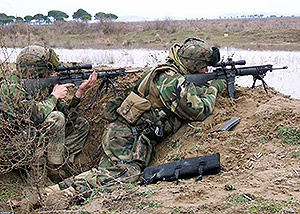 |
| While most think of a military sniper rifle being a .300 Winmag or .50 cal Barrett, many times in close quarters snipers will use weapons that are not much different than regular troops with mostly upgrades to improve accuracy. |
So what are some real world sniper experiences? Here are a couple of stories from the “Real World”.
In Beirut in the 1980s, the U.S. Marines were stationed at an airport and were charged with protecting the perimeter. They were stationed in outposts around the airport but just inside the wire. They could not fire at someone outside the wire unless they were fired on first or had a weapon aimed at them. After a number of Marines were killed by enemy forces, the command determined that they would send out sniper teams to take out these enemy irritants. Firing at ranges under 400 yards, the Marine snipers made their presence known by taking out a number of the enemy and relieved pressure on the Marines in the outposts. Key factors: the enemy was equipped with AK47s and RPGs that could hit the sniper teams thus range was not a factor. The targets the snipers were assigned to hit were not high ranking military officials or anything special. They were regular combatants. The snipers were called in because they had the training necessary to spot them, target them, and eliminate them that standard soldiers lacked. Also, they would remain in the same position for their entire time on the line and target enemies that came into their assigned areas. To some, they what they did might be considered camping but considering the mission of the troops to protect the airfield, they were contributing to that mission and still managed to stay hidden from their targets after repeated shots.
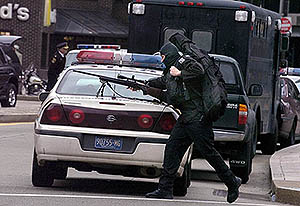 |
| While police sniper units are more apt to use high powered hunting rifles, often times it is because their work in urban invironments predicate a round and weapon that will have penetrating power to strike through glass or brick. Still, their purpose is generally more observation and done at relatively short ranges. |
In a suburb of Los Angeles, LAPD officers were called to a house where a man had barricaded himself inside with a high powered hunting rifle. He took a couple pot shots at officers when they had approached the house and SWAT was called. A SWAT sniper team positioned themselves on the roof of a house across the street to cover the front of the house. Two LAPD officers had taken cover in the man’s driveway behind his car after the man had taken a shot at them. The man came out of the house and began stalking across his front lawn in order to try and get a clean shot at the officers who did not know they were in danger. The SWAT sniper team was holding fire waiting for a green light to engage the man when they determined the officers’ lives were in danger and took the shot just as they received the green light to shoot. Range was under 100 yards and well within the range of the hunting rifle carried by the target.
In Vietnam a U.S. Marine sniper team was out on patrol with a squad of Marines. As they approached a crest the squad leader called for the sniper team to come forward. In front of the squad was a river at the bottom of a small ravine where a VC scout was checking for a place to cross the river. The sniper team held their fire until the scout motioned forward the rest of his unit. Once the lead elements of the unit were half way through the river, the sniper team shot the scout and signaled the rest of the Marine squad to open fire. During the fire fight the sniper team accounted for two more kills. Range was around 200 yards. Once again the targets were of no particular importance but the sniper team was supporting the mission of the squad it was attached to and was firing in support of that mission.
Well? Do they or don’t they?
So, do Paintball Snipers exist? Yes, they CAN. However, it’s not a long barrel, a scope, or a ghillie suit that makes a paintball sniper. So while we have kind of gone over the opposing viewpoints, let me try and quantify my position here.
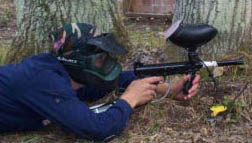 |
Scenario 1 - A player has found a nice little place to hide on the field during a scenario game. He has gone out on his own and doesn’t know what side of the lines he is technically on. He has no mission card nor does he know if any missions are being ran in the area. After a while he sees one player from the other side walking towards his general direction. When in range, the player fires a number of rounds at the enemy player eliminating him. Is this a Sniper? No, it’s a camper. First, he isn’t trying to find a spot where he can influence the outcome of the game. He just figured out someplace to hide and wait for someone to wander by not even knowing if someone would or not. Secondly, the target he picks has no outstanding value. He doesn’t have a prop, he doesn’t look like he’s on a mission, he’s just wandering through the field, and the “sniper” isn’t supporting any particular mission. Third, when the camper does fire it’s not a controlled, single shot but rather a barrage. This is closer to an ambush of one rather than a sniper.
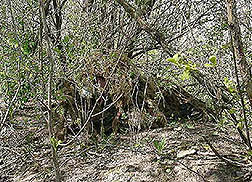 |
Scenario 2 - A player finds out there is a mission being ran that entails his team to go to a location on the field, find, and then retrieve a certain prop. This player figures that the enemy may have a similar mission for the same prop. Rather than go to the prop he decides to place himself between the area where the prop is and where he feels the enemy may advance to the prop area from. He finds a good hiding spot and conceals himself. A few minutes pass and sure enough, here comes the opposing team down a trail. He takes a shot at the front man at about 75 feet and eliminates him. The rest of the unit takes cover and tries to figure out where the shot came from. As one pokes his head out, and looking to the shooting player’s right, the concealed shooter takes a shot but misses by about an inch. The target turns towards the concealed player’s location but does not see him. Instead he fires a bunch of rounds at the general area he thinks the shot came from. The concealed player’s hide is made up of thick branches that break any balls that manage to make it his way and the player stays put not firing back. As the target player turns to say something to his comrades that concealed player takes another shot and this time eliminates the target. After this, the concealed player lays still and doesn’t return any fire. He makes himself as concealed as possible and allows the now nervous opposing force to pass him by. When they have left, he follows their trail. He sees them engage what he feels is his team trying to take the prop and they hunker down again. He finds another good hiding place and proceeds to eliminate two or three more of the opposing force from behind before he himself is eliminated. Is this a sniper? Yes. His delaying of the enemy unit may have bought his team enough time to get the prop before the other team arrived. He used controlled shots, concealment, and a quiet marker to keep the other team from figuring out his position. Also, by allowing them to pass then following after he kept himself in the game and supported his team by providing important support from a direction the enemy wasn’t expecting.
 |
Scenario 3 - A tank is moving up to try and break through the opposing team’s line. Our player has moved up with it to try and give it some infantry support. Looking through his magnification scope, our player sees an enemy Anti-tank team moving into position further up the road to try and take out the tank. Our player, equipped with a FS round compatible marker, maneuvers himself into a position on the opposite side of the road to try and get a shot at the AT gunner. He moves low but quickly keeping cover between him and the last place he saw the AT gunner. He gets to a spot where he thinks he should have a good angle and peers out to see the AT gunner looking around his cover down the road at the tank. Using his magnified mildot scope, our player estimates the range at over 50 yards but under 70 yards and adjusts accordingly. He is well outside the effective range of the support units accompanying the AT gunner and even the rocket of the AT gunner himself. He squeezes off one round and is rewarded by a splat of white paint on the AT gunners shoulder who is standing relatively out in the open because he feels he is safe because he is out of range of most paintball guns. Is this as sniper? Some will say yes, others no. I’d say yes because the equipment and type of play this person is using would qualify him as playing in a “sniper” style. First, he was using a marker designed for single shot eliminations and scouting, both of which are roles of the sniper. He also moved using cover to keep himself out of sight to his target. However, other types of players do this too and yet are not called snipers so this isn’t necessarily what makes this player fall into the “sniper” category even though concealed movement is certainly in the sniper’s bag of tricks. Most importantly though is that he took out an “important target” at the moment with a single shot in order to keep from exposing himself to others that may have been with the AT gunner or from other AT gunners further up the road so that he could continue to support the friendly tank that was moving up. He also did it with a First Strike round which allowed him to shoot out the target at a range that put him beyond the effective range of the opposing sides weapons (unless, of course, one of them were equipped with a FS capable marker too). This would, in just about anyone’s dictionary, be referred to as a sniper.
What makes a “Sniper” setup?
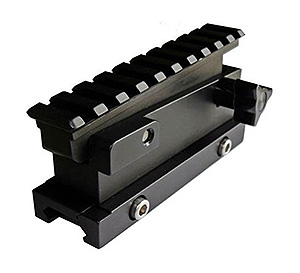 |
| While First Strike rounds fly flatter than regular paintballs, they still drop more than a real life bullett when we're firing at long ranges. If you use a scope with your marker shooting First Strike rounds, a mount like this that will let you angle your scope down for that drop will come in handy as most scopes cannot adjust for this kind of drop properly. |
Since it can be reasonably concluded that today there most certainly can be paintball snipers in scenario and big games, just what would the paintball sniper be shooting and what kind of gear would he or she carry? For today’s sniper, one would almost insist on a marker that is FS compatible. Since a sniper’s greatest asset in a weapon should be accuracy the FS round is a natural choice. Second, he needs a way to put his rounds on target the first time, every time. While it used to be that magnified scopes were pretty useless for paintball (see my guide on scopes and sights) FS rounds have changed that too. Now low power scopes (up to 9x magnification) are far more useful. However, while FS rounds fly flatter than standard paintballs, they still have a substantial drop. Luckily there are a number of products out there now that will let you angle the scope downward to compensate for this drop. One of these would be necessary too.
In addition, a proper sniper needs to have a radio with an earpiece. Let’s face it, you can’t know what is an important target in regards to missions is if you’re in the field and cannot be contacted by your general. The earpiece is so that when you’re trying to stay concealed a burst of radio static doesn’t give away your position.
Beyond that everything else is optional and personal preference. The lighter you run the better as it makes it easier to stay stealthy. Water is also good since you may be in the field a long time. There is no other equipment that would make a sniper that any other player wouldn’t need as well.
Conclusion
Well, there you have it. Is there a place and a role for “snipers” in paintball? I believe so under certain conditions. To avoid starting any fights are arguments on the field I would never refer to myself as a sniper though. I’d prefer to just play the way I like to play and let others label me however they want. So long as your making the contribution, who cares how you do it so long as it’s within the rules?
Good luck and remember, it is all about having fun!
- Robotech
Back to the home page...
|
